Does ChatGPT recommend you? How to measure your brand’s AI visibility
 Alejo Pietra Bergallo SEO & GEO consultant · Founder of Pietra Mundo Digital

To know whether AI recommends your brand you have to ask it systematically: run the same questions your customers would ask in ChatGPT, Gemini, Perplexity and Google AI Overviews, record whether you appear, in what position and which sources are cited, and repeat it every month. Without that measurement, any GEO work is done blind.
Why isn’t Search Console enough?
Because Search Console shows how you appear in Google’s results, not what an assistant answers when someone asks for a recommendation. A generative answer has no fixed positions and no ten links: it is a piece of text that mentions some brands and not others, and it changes with the wording of the question.
What these systems say isn’t always right, either. Columbia University’s Tow Center for Digital Journalism tested eight AI search tools with 1,600 queries in March 2025: overall, they misattributed the source of content in more than 60% of cases, with huge differences between tools (Perplexity got 37% wrong; Grok 3, 94%). If assistants can misattribute a major outlet’s article, it is worth checking what they say about your brand.
Which prompts to use
Start with a list of 20 to 50 questions in three groups:
- Category: “which SEO consultancy would you recommend in Madrid?”, “best tools for…”. These decide whether you make the shortlist.
- Problem: “how do I get ChatGPT to recommend my site?”, “why has my organic traffic dropped?”. Here you compete with content, not just brand.
- Brand: “what do you think of [your brand]?”, “[your brand] vs [competitor]”. Useful for spotting outdated or wrong information.
Use your customers’ language, not yours. Questions from your sales team, Search Console queries and emails from prospects are the best source.
What to record in each answer
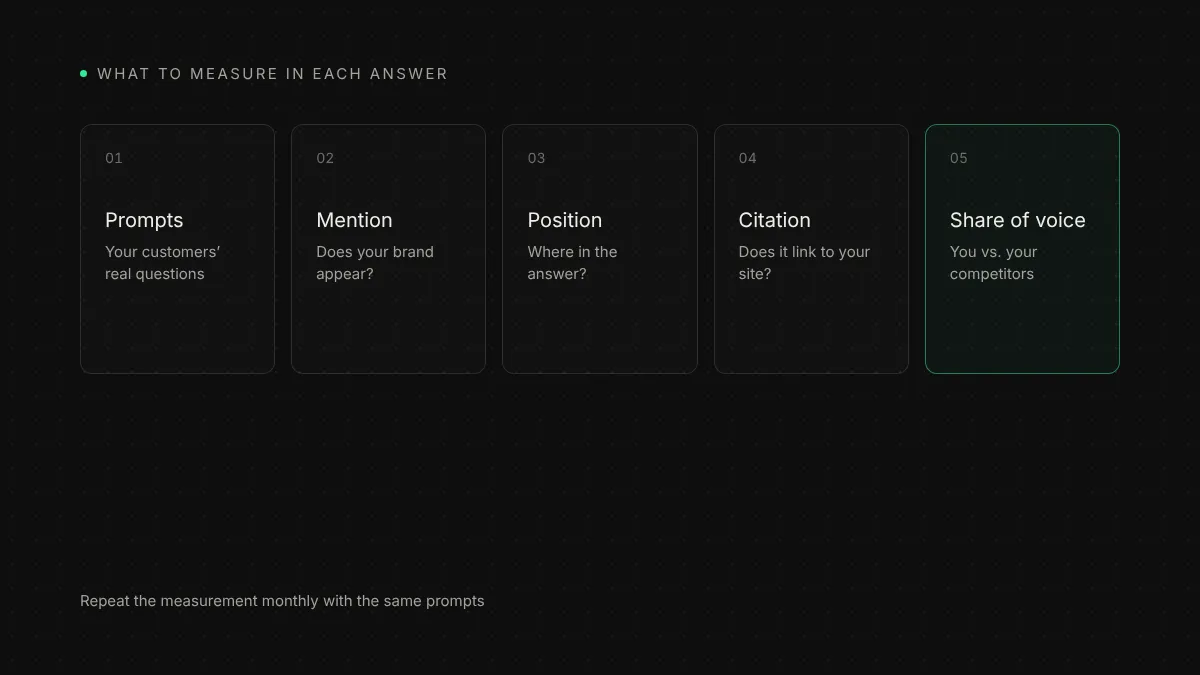
- Mention: does your brand appear? Yes or no.
- Position: if it does, is it the first option or the fifth?
- Citation: does the answer link to your site or to a source about you?
- Cited sources: which sites the assistant relies on. Those are the ones you need to know and, ideally, be featured in.
- Share of voice: of all brand mentions across your prompts, what percentage is yours versus your competitors.
A spreadsheet is enough to start: one row per prompt and one column per assistant.
How often to measure?
Once a month, with the same prompts, the same setup (logged out or with a clean account) and, if possible, from the same location. Answers vary from day to day, so the trend matters more than any single result.
What to do with the data
The data tells you where to act. If you don’t appear in category prompts, the problem is usually authority and presence in the sources the assistant uses. If you appear without a link, your site lacks citable content. And there is good news: the academic paper that coined the term GEO, presented at KDD 2024, found that content improvements especially help sites that start from lower positions.
Start by knowing where you stand
Our GEO service runs this measurement for you, benchmarks it against your competitors and turns it into an action plan. If you want to see how AI sees you today, get in touch.