AI Overviews and clicks: what happens when Google answers for you
 Alejo Pietra Bergallo SEO & GEO consultant · Founder of Pietra Mundo Digital

When a search triggers an AI Overview, organic CTRShare of impressions that end in a click: clicks divided by the number of times the result was shown. drops sharply (in Seer’s study, from 1.45% to 0.52% when your brand is not cited), but the exact figure depends on which queries, which sites and which method you look at. The useful move is not to memorise one percentage but to measure your own queries and work to get cited.
AI OverviewsAI-generated summaries Google shows above the results for some searches, with links to the sources it uses. are the AI-generated summaries Google places above the traditional results. For a year now the studies have been saying different things, so here we put them side by side: what each one measures, where they disagree and which decisions you can take without waiting for a definitive number. This article is part of our series on GEO, optimising to be visible in AI answers.
What does each study measure, and why do they differ?
They differ because they measure different things: some compare queries with and without a summary, others look at a site’s total traffic, others at all searches. Here is each one, with its limits.
| Study | What it measures | Headline figure | Limit |
|---|---|---|---|
| Seer Interactive (Nov 2025) | CTR per query, 3,119 informational terms, 42 organisations | Organic CTR 1.45% without AIO, 0.52% with AIO | Seer’s own clients, non-random sample |
| Amsive (Apr 2025) | CTR across 10 sites in 5 sectors, 700,000 keywords | −15.49% on average for keywords with AIO | Only 10 sites, Amsive clients |
| Digiday with Digital Content Next (Aug 2025) | Referral trafficVisits that reach a site from another site, such as a search engine, rather than by typing the address directly. from Google at 19 US publishers | Year-on-year median of −10% | Small sample, attribution by correlation |
| SparkToro (Jun 2026) | Zero-click searchesA search that ends without the user clicking any result because the answer is resolved on Google’s own page., Similarweb panel, US | 68.01% without a click | Different panels across years, no EU figure |
A note on reading them: Seer and Amsive report CTR (the share of impressions that end in a click) on queries with a summary. Digiday reports a site’s total traffic, where AIO queries are only a part. So a −15% CTR on keywords with AIO and a −10% drop in overall traffic do not contradict each other: they sit on different scales.
How much does CTR fall with an AI Overview?
In Seer’s data, third-quarter 2025 organic CTR was 1.45% without an AIO (−46.2% year on year), 0.52% with an AIO that did not cite the brand (−65.2%) and 0.70% with an AIO citing the brand (−49.4%). Paid results follow the same pattern: 13.88% without an AIO, 4.14% with an AIO and no citation, 7.89% with one.
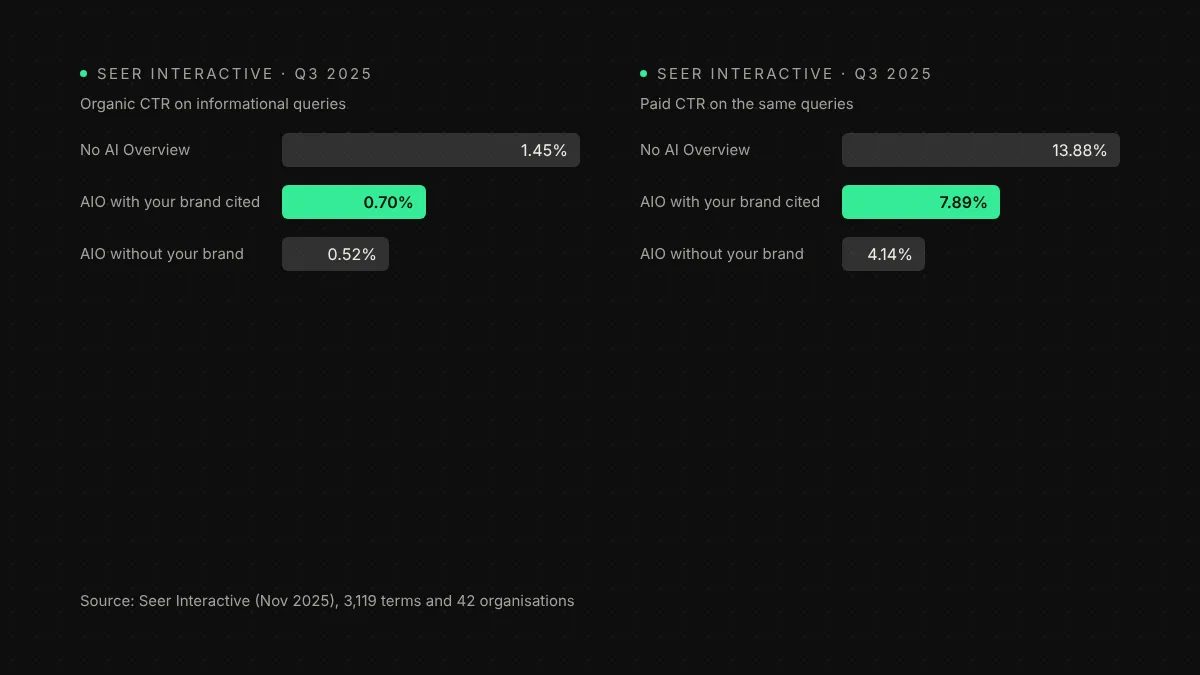
Read these carefully. They rest on 3,119 informational terms from 42 organisations and 25.1 million organic impressions, but all of them are the agency’s own clients, so it is not a random sample of the web. The study page also carries another section with slightly different figures (1.2% organic and 11.05% paid when cited), so we use only the quarterly averages. And the study itself is cautious: «We cannot definitively prove that citation causes higher CTRs». A better CTR for cited brands is a correlation, not proof of cause.
What changes when your brand is the subject?
Quite a lot, in two directions. Amsive’s study, covering 700,000 keywords across 10 sites (with 10,000 AIO keywords analysed), measured an average CTR drop of 15.49% on keywords with an AI Overview. Split it up and the differences are large:
- Non-brand keywords: −19.98%.
- Outside the top 3: −27.04%.
- AI Overview alongside a featured snippetHighlighted answer Google shows in a box above the results, pulled from one of the ranking pages. (Google’s direct-answer box): −37.04%.
- Brand keywords: CTR rises 18.68%, but only 4.79% of them triggered an AIO.
The practical reading is twofold. If people search your name, there is rarely a summary and the click holds. If they search the topic you explain, with no brand involved, that is where most is lost. Same caveats apply: 10 sites, all Amsive clients, and the exact period is not stated.
Does it show in a site’s total traffic?
Yes, but less than the CTR headlines suggest. According to Digital Content Next data reported by Digiday, 19 US publishers had a year-on-year median of −10% in referral traffic from Google Search between May and June 2025: −7% for news and −14% for non-news content. Most lost between 1% and 25%.
The sample is a small group of large publishers, and attributing the drop to AIO is by correlation: Google updates and seasonality also move traffic. The data comes from Digital Content Next, not from Digiday.
And zero-click searches overall?
In SparkToro’s study with a Similarweb panel, between January and April 2026 «a whopping 68.01% of Google searches ended without a click» in the US, up from 60.45% in 2024 and 49% in 2019. Only 31.99% ended in any click, and just 0.34% reached AI ModeGoogle’s conversational AI search mode: you chain questions together and get composed answers with links to the sources., Google’s conversational mode.
The limits are specific: it compares different panels across years, gives no EU figure and counts clicks to Maps or YouTube as clicks. It shows the trend (more and more searches are resolved inside Google), not an exact share for your sector.
Can optimising for AI Overviews win clicks? The Trex case
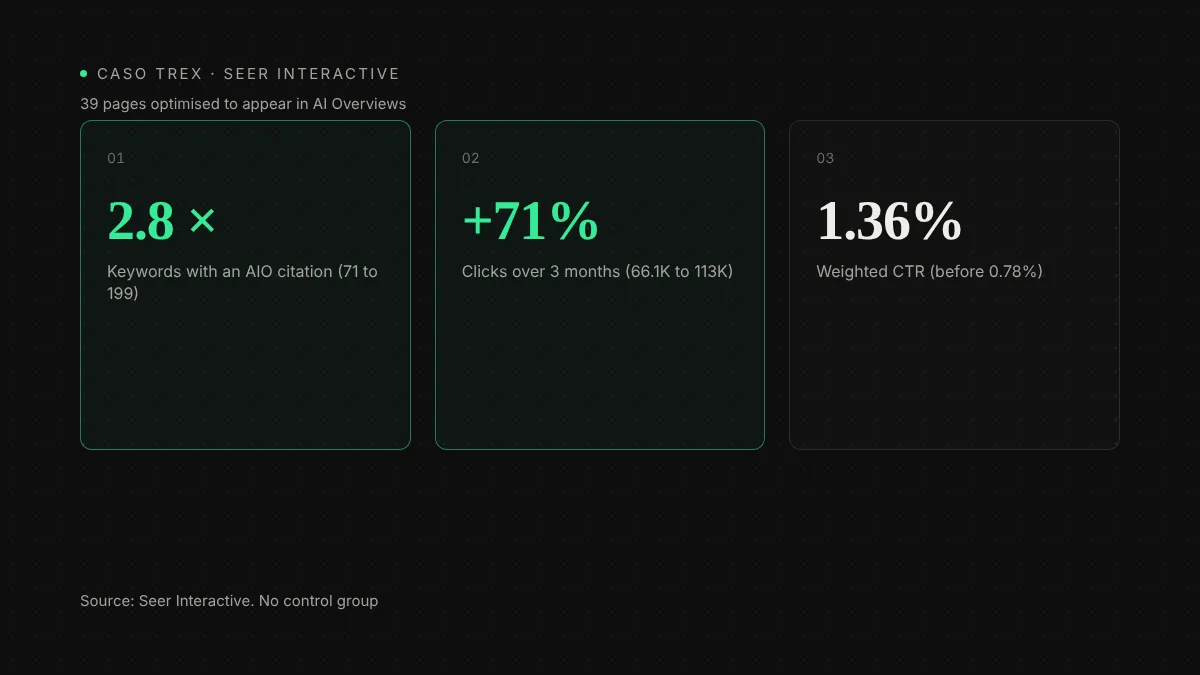
There is one published case where it did. Seer Interactive optimised 39 Trex pages to appear in AI Overviews, and according to its case study:
- Keywords with an AIO citation went from 71 to 199 (2.8x) year on year.
- Over the last three months, the optimised pages earned 113K clicks against 66.1K (+71%), with stable impressions.
- Weighted CTR rose from 0.78% to 1.36% and average position improved from 6.28 to 3.08.
- 17 of the 39 pages (44%) improved on both citations and clicks.
Seer sums it up as a «traffic driver rather than a traffic suppressor». With caveats: it is told by the agency that did the work, there is no control group, exact dates are not given and the position gain explains part of the CTR improvement. Even so, it shows that getting cited and ranking higher can offset part of the loss.
What should you do with all this?
With figures that disagree, the sensible path is to measure your own and act on three fronts.
- Measure your own queries. In Search ConsoleFree Google tool that shows how Google crawls, indexes and ranks your site, and which searches bring users to it., export informational queries and look for pages with stable impressions and falling CTR. Split brand from non-brand: according to Amsive, the impact is very different. Cross-check against queries where you know a summary appears.
- Work to get cited. Direct answers up front, sourced data and a clear structure. Seer’s data suggests being cited goes with a better CTR, though it does not prove it causes it. In measuring AI visibility we explain how to check whether you are cited.
- Give people a reason to click. A tool, a template, a case with your own data, a quote: what the summary cannot deliver. Non-brand informational queries are the most exposed, so there your content has to offer more than the definition.
To see how this plays out in real cases from recent weeks, read the case studies of week 47 and the SEO and GEO news of the week.
What we still don’t know
None of these studies is a neutral measurement of the whole web: they use agency clients, US panels or large publishers. We have no reliable figure for Spain or the EU, and the link between AIO and lost clicks remains a correlation in most cases. That is why we insist on measuring your own site before making content decisions.
Want to know how much it affects you?
We review which of your queries trigger AI summaries, how much CTR you have lost and where you can win citations. That is what we do in our GEO service. If you want to start there, get in touch.