Best AI visibility tools (November 2026)
 Alejo Pietra Bergallo SEO & GEO consultant · Founder of Pietra Mundo Digital
Updated: 22 November 2026

By our criteria, the best tool for tracking your brand’s visibility in AI in November 2026 is Rankscale (88.3 points out of 100), followed by Otterly.AI (84.2) and Peec AI (83.5). It is a monthly ranking: this page is updated every month with the same criteria, so you can see who moves up, who drops and why.
This is our ranking, not a universal truth: it rests on public information as of November 22, 2026, no tool has paid for its position and we have not lab-tested every product. The full method (what a tool measures, how we score and its limits) is at the bottom of the page.
How do the tools compare at a glance?
Tap any tool’s name to jump to its analysis. The table scrolls sideways on mobile. The weights are: coverage 20, connectivity 15, accuracy 15, promptThe question or instruction typed into an AI assistant. In AI visibility, each prompt is a customer query that is repeated to see whether the brand shows up. runs 10, updates 10, pricing 10, value 10 and UX 10 points. SISTRIX (position 11) is outside the top 10 and shown as an extended entry.
| # | Tool | Points | Entry price | Distinct platforms | API · MCP · Data Studio | Prompt runs | Cov. | Conn. | Acc. | Runs | Upd. | Pric. | Val. | UX |
|---|---|---|---|---|---|---|---|---|---|---|---|---|---|---|
| 1 | Rankscale | 88.3 | €99 (Pro) | 10 | Yes · Yes · Yes | Configurable, hourly to bimonthly | 8.9 | 9.5 | 7.5 | 10 | 8 | 10 | 8 | 9 |
| 2 | Otterly.AI | 84.2 | $29 (Lite, 15 prompts) | 12 | Yes · Yes · Yes | Daily or weekly | 9 | 10 | 8.8 | 7 | 6 | 9 | 6 | 10 |
| 3 | Peec AI | 83.5 | $95 (Starter, 50 prompts) | 15 | Yes · Yes · Yes (Advanced) | Daily | 6.9 | 9 | 8.8 | 9 | 6 | 10 | 8 | 10 |
| 4 | LLM Pulse | 82.5 | From €49 | 21 | Yes · Yes · Yes (Scale) | Daily, weekly or monthly | 9.5 | 10 | 5 | 7 | 6 | 10 | 9 | 9 |
| 5 | AthenaHQ | 71.7 | Free (300 credits); $295 | 11 | Yes (add-on) · Yes · Not stated | Not stated | 9 | 7 | 8.8 | 5 | 2 | 8 | 5 | 10 |
| 6 | Ahrefs Brand Radar | 71.5 | From $199 | 7 | Yes · Yes · Not stated | Daily, weekly or monthly | 8 | 7 | 6.3 | 7 | 8 | 6 | 8 | 6.5 |
| 7 | LLMrefs | 70.5 | $79 (500 weekly prompts) | 10 | Yes · Not stated · Not stated | Weekly | 10 | 7 | 6.3 | 4 | 2 | 9 | 8 | 7.5 |
| 8 | Scrunch | 69.6 | $250 (Core) | 8 | Enterprise · Yes · Enterprise | Daily (Core) | 7.9 | 7 | 7.5 | 9 | 2 | 8 | 5 | 8 |
| 9 | Profound | 66.3 | Not visible at first glance | 10 | Yes · Yes · Not stated | Daily | 8.9 | 8 | 6.3 | 9 | 10 | 1 | 0 | 7 |
| 10 | Semrush | 57.2 | $199 (SEO + AI bundle) | 4 | Not stated · Yes · Not stated | Daily | 5.6 | 7 | 5 | 9 | 2 | 5 | 6 | 6 |
| 11 | SISTRIX | 54.2 | Included from €119 | 4 | Yes · Yes · Not stated | Not stated | 4.6 | 7 | 5 | 5 | 2 | 6 | 7 | 7 |
What does each tool offer?
Position 1: Rankscale
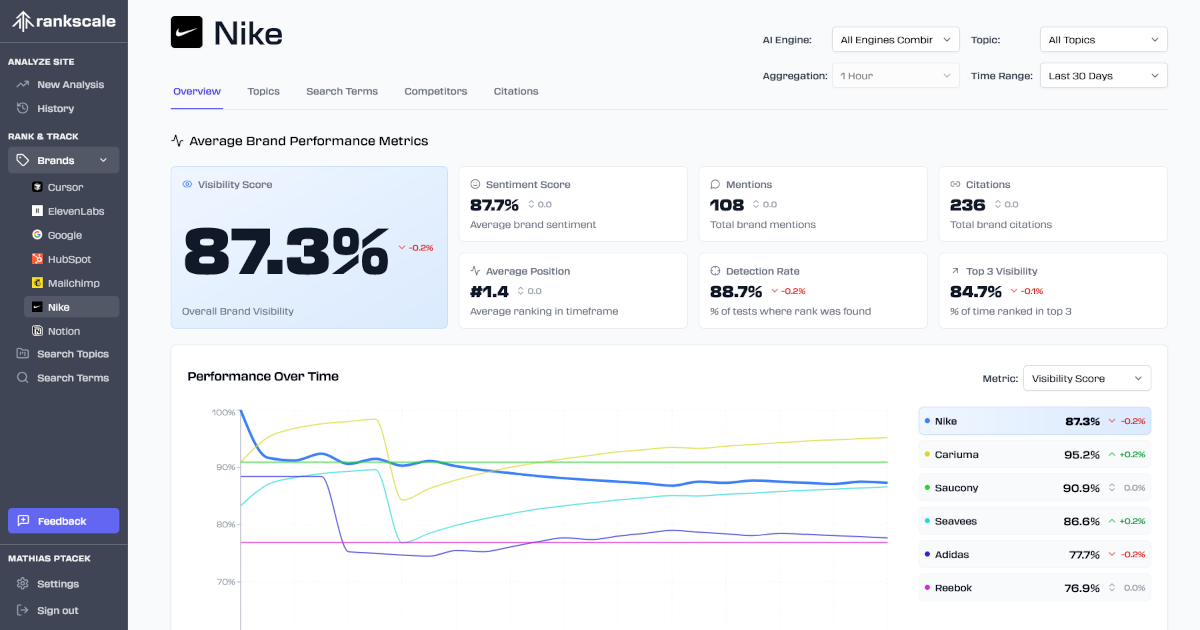
88.3 points
It struck us as the most well-rounded offer of the month, winning on both the practical side and the fine print. It has four plans with visible prices (Pro €99, Pro+ €229, Growth €385 and Enterprise €780, 15% less if you pay yearly) and a 7-day trial on Pro. What sets it apart most is frequency: for each prompt you choose whether it runs hourly, every two hours, daily, weekly, monthly or manually, a granularity we have not seen elsewhere. On connectivity it is among the most complete: an MCPModel Context Protocol: an open standard that lets an AI assistant connect to a tool to read its data or run actions. server for Claude, ChatGPT and Cursor on every plan, a REST API from Pro+, Data Studio integration, CSV and Sheets exports, white-label dashboards and reports from Growth, unlimited seats from Pro and an agency programme with a Slack channel and partner directory. Its coverage includes Claude and every country and language, although we saw that “17+” is about ten platforms. Its updates are frequent (six or more in the last quarter). What we have not seen is a dedicated mode for pitching to prospects.
Position 2: Otterly.AI

84.2 points
It is the one most geared to agencies that pitch, and its connectivity is among the best in the ranking. According to its pricing page, Lite costs $29 with 15 prompts, Standard $189 with 100 and Premium $489 with 400. It includes API and MCP with a request cap per plan (Lite has no access, Standard 2,000 a month and Premium 5,000), a Data Studio connector, custom Data Studio reports with the agency’s branding and pitch workspaces for building tailored audits for a prospect. It tracks 12 platforms, all distinct and Claude included, with daily or weekly runs, plus unlimited seats and a free trial. It keeps a changelog and scores well on accuracy. What holds it back is that each plan tracks only three platforms at a time and that Claude uses more credits than the rest, so the real range depends on the plan you pay for.
Position 3: Peec AI
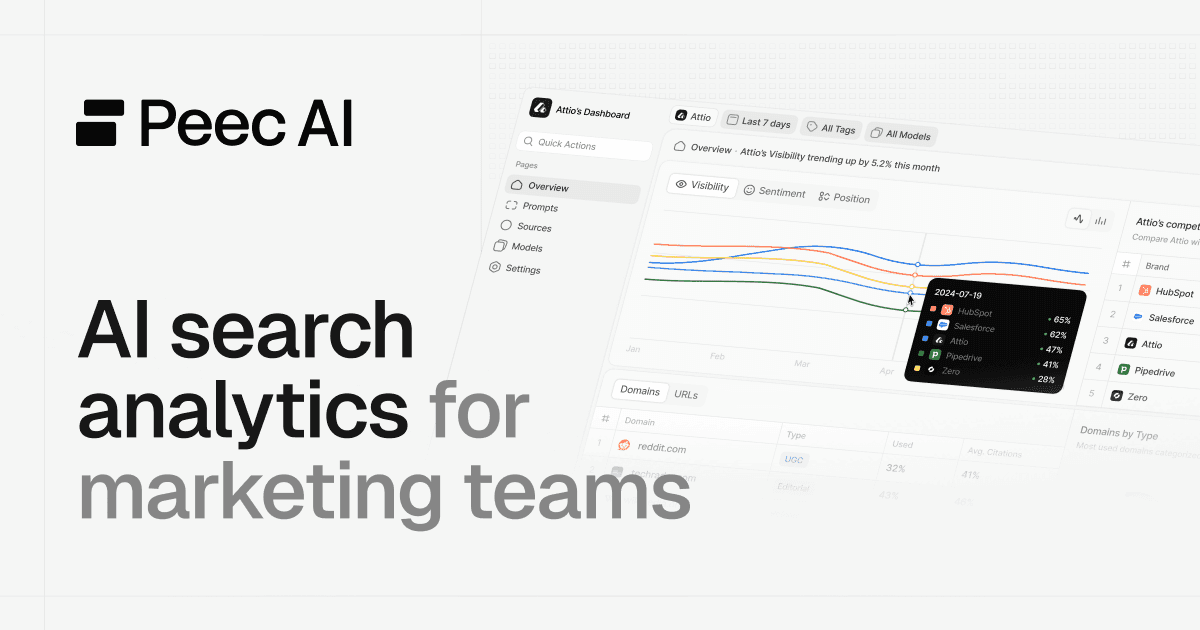
83.5 points
It best combines accuracy and ease of use, and sits less than a point behind second place. Starter is $95 with 50 prompts, Pro $245 and Advanced $495, with daily runs on every plan (daily or weekly on Enterprise). The MCP server comes on every plan, the API from Pro, the Data Studio connector from Advanced, Google Analytics on all of them, CSV exports and unlimited seats, and agencies can manage several brands with centralized billing. Its list of 26 “platforms” includes variants from the same provider, so it is really about 15, including Naver, ERNIE, Qwen and Claude. Third parties rate it highly: the September 2026 metehan.ai test picks it as the best option for citation intelligence, and MRS Digital compared it with Ahrefs and Otterly. The drawbacks are the base plan’s coverage (three active models at a time, and one country on Starter versus three on Pro) and that we have not seen white-label or a prospect pitch mode. It posts updates almost every week.
Position 4: LLM Pulse
82.5 points
It is the one we have used the most, and that shapes how we describe it. It runs prompts daily across the Google ecosystem, ChatGPT and Perplexity, and keeps all the data connected through MCP and API to AI tools, which makes a difference when you want advanced analysis. It keeps adding improvements steadily: in its changelog we see them monthly and, day to day, almost week by week. It is a fully Spanish company, which comes with its own difficulty against the big international players. Its connectivity is among the best in the ranking: MCP on every plan, API, Data Studio, Zapier, webhooks, Make, n8n and Power BI from the Scale plan, exports in CSV, Excel and PDF, white-label on Enterprise and Partner, and pitch projects for agencies (three a month on Scale). It tracks 21 distinct platforms, including Claude, Copilot and Grok, shopping assistants such as Amazon Rufus and Walmart Sparky, and Asian search engines such as Naver and Baidu. Plans can run weekly, monthly or daily, and the 14-day trial is on the weekly plan. Its pricing page starts at €49. Its lowest score is accuracy, because that is where we found the least public documentation. Disclosure: it is one of the tools we have used the most. It ranks fourth, and the rubric is identical for every tool.
Position 5: AthenaHQ
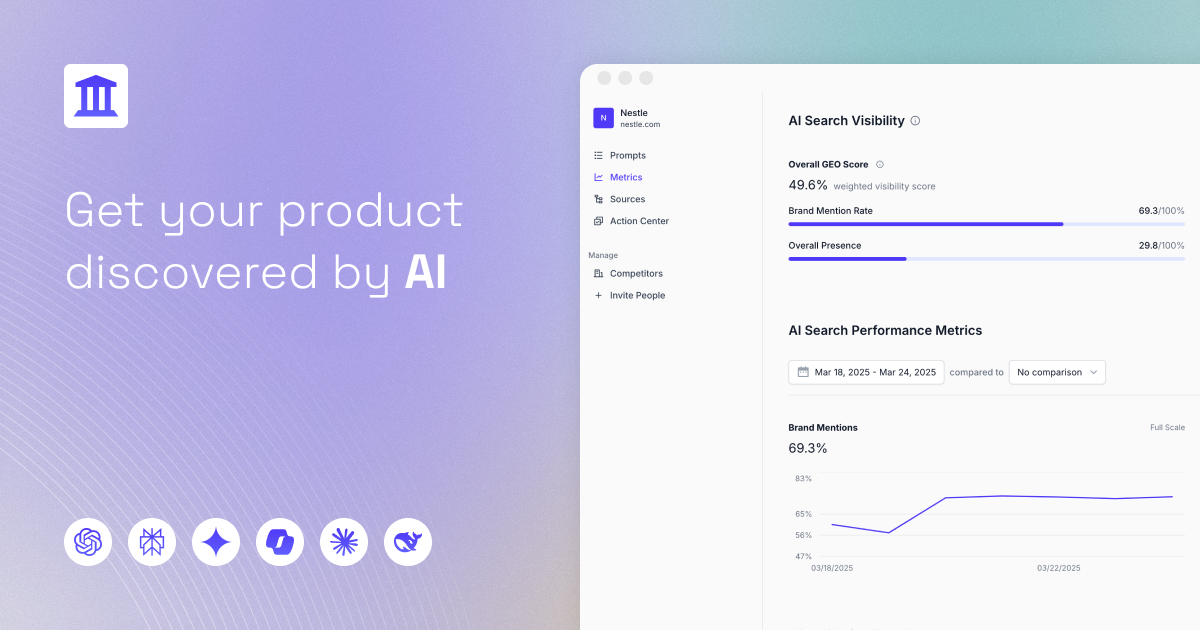
71.7 points
On coverage it is still one of the most impressive: 11 distinct platforms, including Claude, Grok, DeepSeek, Meta AI and Mistral, and a free plan with 300 credits to try it without commitment. On connectivity it has an official MCP server in Claude’s connector directory, an API as a paid add-on on Starter and included on Enterprise, integrations with Shopify, Webflow, GA4 and Search ConsoleFree Google tool that shows how Google crawls, indexes and ranks your site, and which searches bring users to it., CSV export and unlimited seats with role-based permissions. It also cites compatibility with Tableau, Power BI and Looker. Its plans page does not say how often it runs prompts, and we have seen no dated updates in the last 90 days (see its changelog), and the next step up, $295 with 3,600 credits, strikes us as a big jump. It fits e-commerce on Shopify well.
Position 6: Ahrefs Brand Radar

71.5 points
If you already live in Ahrefs, it is the logical choice. It covers seven platforms with custom prompts, Claude among them, and its overall index gathers more than 581 million prompts from six AI tools. Custom prompts can run daily, weekly or monthly, and there are packs from $50 (2,500 checks), although the full index starts at $199 and reaches $699 with every model. Ahrefs’ MCP server and API include Brand Radar-specific tools, which makes it easy to bring the data into an AI assistant. Its product page does not detail connectors or exports, so those points count as unverified. Its pace of updates is good; what convinces us less is what it costs to have everything.
Position 7: LLMrefs

70.5 points
It is the most ambitious in reach: 11 platforms listed (ChatGPT and ChatGPT Search appear separately), Claude included, and segmentation across more than 50 countries and more than 20 languages, although another part of its site mentions 20 countries and 10 languages. According to its pricing page it costs $79 with 500 weekly prompts, and includes an API, CSV export, weekly reports, per-client dashboards, unlimited projects and seats and a 7-day trial. We have not found an official MCP server or a Data Studio connector. Where it falters is pace: it runs only once a week and we saw no dated changelogA page where a tool publishes, with dates, the new features and changes in each release., which costs it points on runs and updates.
Position 8: Scrunch
69.6 points
It has muscle on paper and runs daily. According to its pricing page, it starts at $250 with 15,000 prompts, eight platforms (Claude only as an add-on) and any country, language and persona. Core includes one brand, five seats and an MCP server; Enterprise adds unlimited brands and seats, API, a Data Studio connector and daily or every-three-days runs. There is data export on both plans and a 7-day trial. What it lacks is mostly openness: the API and Data Studio are reserved for Enterprise and we could not verify dated updates in 2026, which weighs in a market that changes every month.
Position 9: Profound
66.3 points
It moves the fastest and is among the most open to integrating with AI. It has 11 changelog entries, roughly one a week, up to ten platforms (with Claude), daily runs and an official MCP server that is hosted and read-only, giving an assistant access to visibility, citations, sentiment and AI bot traffic. It adds an API, SDKs, CSV and JSON export and integrations with Google Analytics and infrastructure providers such as Cloudflare, Vercel and AWS. What holds it back is that its prices are not visible on the first screen, at least from what we have seen, and that in September 2026 it withdrew its public plans. In a rubric that rewards transparency and value, that leaves it ninth despite its strong connectivity.
Position 10: Semrush

57.2 points
It holds a top 10 place on connectivity, although its coverage is short. Its public price is a $199 bundle combining SEO and AI search, with 50 daily prompts, and the toolkit documentation describes daily prompt tracking, up to 220 countries and territories, PDF and CSV exports (up to 1,000 rows per export and 10 a day) and “presentation-ready” reports. Semrush offers an MCP server and API across its suite, although it does not clarify the exact scope for this module. It only names ChatGPT, Gemini, Google and AI ModeGoogle’s conversational AI search mode: you chain questions together and get composed answers with links to the sources., without Claude, and the toolkit has no free trial. Its pricing page and its blog also contradict each other ($199 versus $99). If it clarifies coverage and price, it will move up.
Position 11: SISTRIX
54.2 points · outside the top 10
An interesting add-on if you already work with SISTRIX, but as a dedicated tool it is the least complete. Its AI visibility module, still in beta, comes inside packages from €119, with 100 prompts a month on the Start plan, four platforms (ChatGPT, Perplexity, AI OverviewsAI-generated summaries Google shows above the results for some searches, with links to the sources it uses. and AI Mode) and a 14-day trial. SISTRIX offers an API and MCP server for its suite, and the module measures domains’ presence in AI answers more than it tracks your own prompts. On its page we have not found the module’s run frequency, connectors or exports. We show it as an extended entry, as we will every month with tools that fall out of the top.
Which tool fits your case?
If entry price is your priority, look at LLMLarge language model: the kind of AI behind ChatGPT, Gemini or Claude, which generates text from patterns learned over huge volumes of text. Pulse, Otterly.AI or Peec AI. If you need the widest platform coverage, LLM Pulse, Otterly.AI or AthenaHQ. If you work for an agency and pitch to prospects, Otterly.AI and LLM Pulse have pitch workspaces, and Rankscale has white-label from Growth. If you want to connect everything to your own AI through MCP, Rankscale, Peec AI, LLM Pulse and Profound all offer it. If you already work with an SEO suite, Ahrefs Brand Radar, Semrush or SISTRIX save you one more tool. And if you want the fastest product pace, Profound and Rankscale are the most active, although Profound requires going through sales.
How did we run this study?
What does an AI visibility tool do?
It repeatedly sends the same prompts (the questions a customer would ask) to ChatGPT, Gemini, Perplexity, Google AI Overviews and other assistants, and records whether your brand shows up, in which position, with what tone and which sources are cited. It automates what we describe in how to measure your brand’s visibility in AI, and it is the foundation of any serious GEO work.
Do more models mean better coverage?
Not necessarily, and it is the easiest mistake to make when comparing. The “engine” counts these tools advertise mix different things: real interfaces people use (ChatGPT, AI Mode, AI Overviews) and versions of the same model queried through an API. Rankscale’s pricing page boasts “17+ engines”, but its list includes GPT-5, GPT-5.6 and GPT-6.1, three versions of Claude and three of Gemini: that is about ten distinct platforms. Peec AI’s lists 26, including four OpenAI variants and four Claude variants, which comes to about fifteen. LLM Pulse, by contrast, lists 21 and all of them are distinct.
That is why the rubric counts distinct platforms, not model versions, and adds points for tracking Claude (not every tool does: Semrush and SISTRIX do not name it, and Scrunch only offers it as an add-on) and for allowing segmentation by country and language. There is also a difference that matters: what a model answers through an API does not always match what a person sees in the app. Measuring through an API is cheaper and steadier, and measuring the interface is closer to real experience. Tools that tell the two apart, such as Rankscale and Peec AI, let you choose.
How did we score them?
We used an eight-criterion rubric (version 2, November 22, 2026) applied by a script, with no manual intervention, so the result is reproducible:
- Coverage (20 points): how many of the seven main platforms it really tracks (ChatGPT, Gemini, Perplexity, AI Overviews, AI Mode, Claude and Copilot), whether it adds others, whether it allows any country and language and whether it limits how many you can track at once. It counts distinct platforms, not model versions.
- Connectivity and reporting (15): API, MCP server, Data Studio connection, exports, white-label reports and workspaces for pitching to prospects instead of running full audits.
- Data accuracy (15): public signs of rigor: how it collects answers, whether you can inspect them, whether it fact-checks and whether it publishes evidence of stability.
- Prompt runs (10): how often it runs the prompts and whether you can configure it. Daily and configurable scores higher than weekly.
- Update frequency (10): how many dated updates it has published in the last 90 days.
- Pricing transparency (10): whether you can tell what it costs without talking to sales.
- Value for price (10): what it costs to start on a plan that tracks at least 50 prompts.
- UX (10): free trial, integrations, team seats and in-product recommendations.
Two honesty rules. First, anything we could not verify counts as half a point, not zero: “not verified” is not “does not do it”. Second, accuracy and UX are provisional: they rest on public signals, not on hands-on testing. We will replace them with our own tests over time.
We update this ranking every month, on this same page.
What are the limits of this ranking?
- Accuracy and UX are provisional. They rest on public signals, not on our own tests.
- Something missing from a page does not mean it does not exist. Product pages do not always detail connectors, exports or frequency, and those points count as half a point.
- Value for price is not normalized. A $29 plan with 15 prompts and a $295 plan with credits are not comparable one to one; the rubric only looks at the entry price of a useful plan (50 prompts or more).
- Currencies are not converted. Euros and dollars are compared as they are.
- Sources sometimes disagree with themselves. Where a tool contradicts itself, we use the current pricing page and say so.
- Data as of November 22, 2026. Prices and plans change often; confirm them on each tool’s site before buying.
Want help choosing and setting up the right tool, and turning the measurements into action? It is part of our GEO and AI visibility service. You can also see how clicks change when Google answers with AI in AI Overviews and clicks or write to us directly.