How to write content AI will cite: answers, data and sources
 Alejo Pietra Bergallo SEO & GEO consultant · Founder of Pietra Mundo Digital

AI assistants cite mostly what sits at the top of the page, written with clear definitions and specific proper names, and they do so even when your site isn’t in Google’s top ten. The available studies are observational, so they describe patterns, not guarantees. Even so, they give fairly practical clues for rewriting a text.
This article covers where citations come from, which language gets cited, how that relates to traditional rankings, which two published cases have tried these ideas, and how to turn it all into a checklist. It is part of our GEO series (Generative Engine Optimization: the work of getting ChatGPT, Gemini, Perplexity or Google to cite your brand; also called AEO, LLMO or AI SEO).
Where on the page do assistants cite?
In the first third. Kevin Indig analysed 18,012 verified ChatGPT citations in a study published on Search Engine Journal in February 2026, using data from Gauge. He measured which part of the page the cited passage came from, comparing embeddingsA numerical representation of the meaning of a text, which makes it possible to compare how similar two passages are. (numerical representations of a text’s meaning) with a minimum cosine similarityA measure of how alike two embeddings are, from 0 to 1: the closer to 1, the more similar. of 0.55.
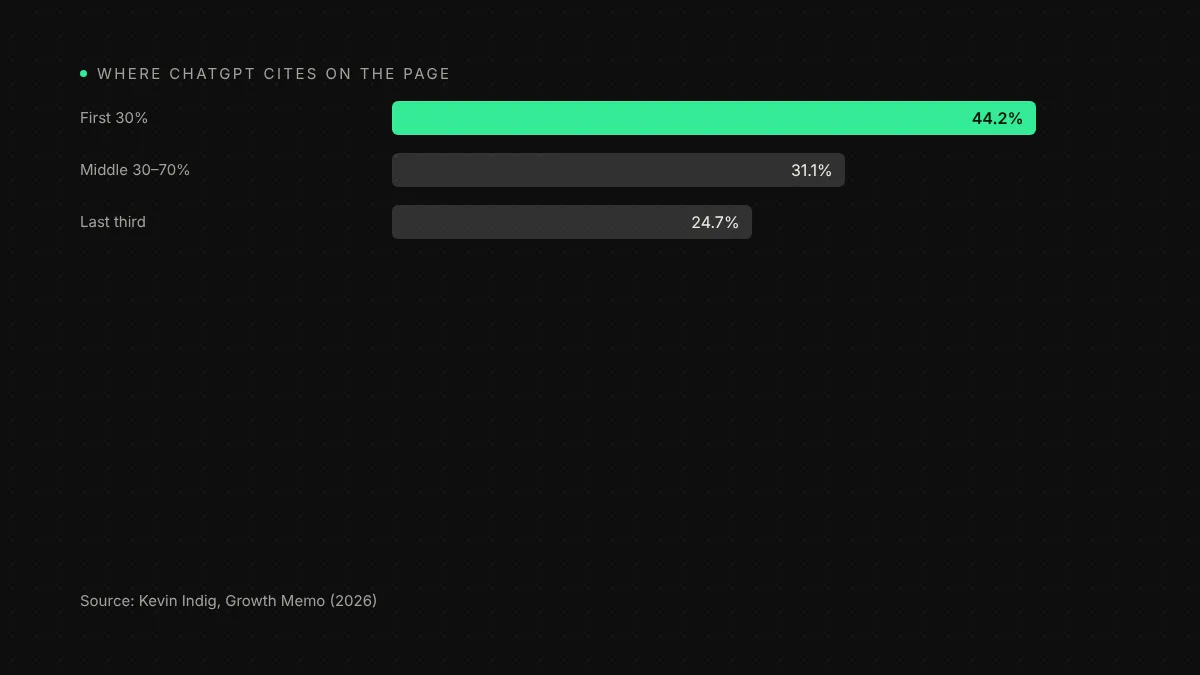
The split was:
| Position on the page | ChatGPT citations |
|---|---|
| First 30% | 44.2% |
| 30% to 70% | 31.1% |
| Last third | 24.7% |
Indig puts it like this: “ChatGPT pays disproportionate attention to the top 30% of your content.” The practical consequence is uncomfortable for many pages: long introductions, preamble anecdotes and definitions that show up in the fourth paragraph spend exactly the stretch that gets cited most.
A caveat on the study: it is correlational, covers only ChatGPT, relies on an external data provider, and the author claims stronger statistical significance than an observational analysis can support. Treat it as a clue, not a rule. Testing it costs nothing, though: moving the answer to the top also improves the page for any human reader.
What kind of language gets cited most?
The kind that defines and names. In the linguistic part of the same study (11,022 citations), Indig found that the most cited texts had 20.6% proper nouns, against 5-8% in normal English. Explicit definitions stood out too: 36.2% versus 20.2% in the comparison.
In writing terms:
- Define in one sentence. “Crawl budgetHow many URLs a search engine can and wants to crawl on a site in a given period. It matters mostly on very large sites. is the number of pages Google is willing to crawl on your site” can be lifted as is. “Many factors influence crawling” cannot.
- Name things. Brands, people, products, tools, places. A text full of “industry solutions” gives the model nothing to hold on to.
- Skip the detour. Every sentence that doesn’t define, name or add a fact dilutes the passage.
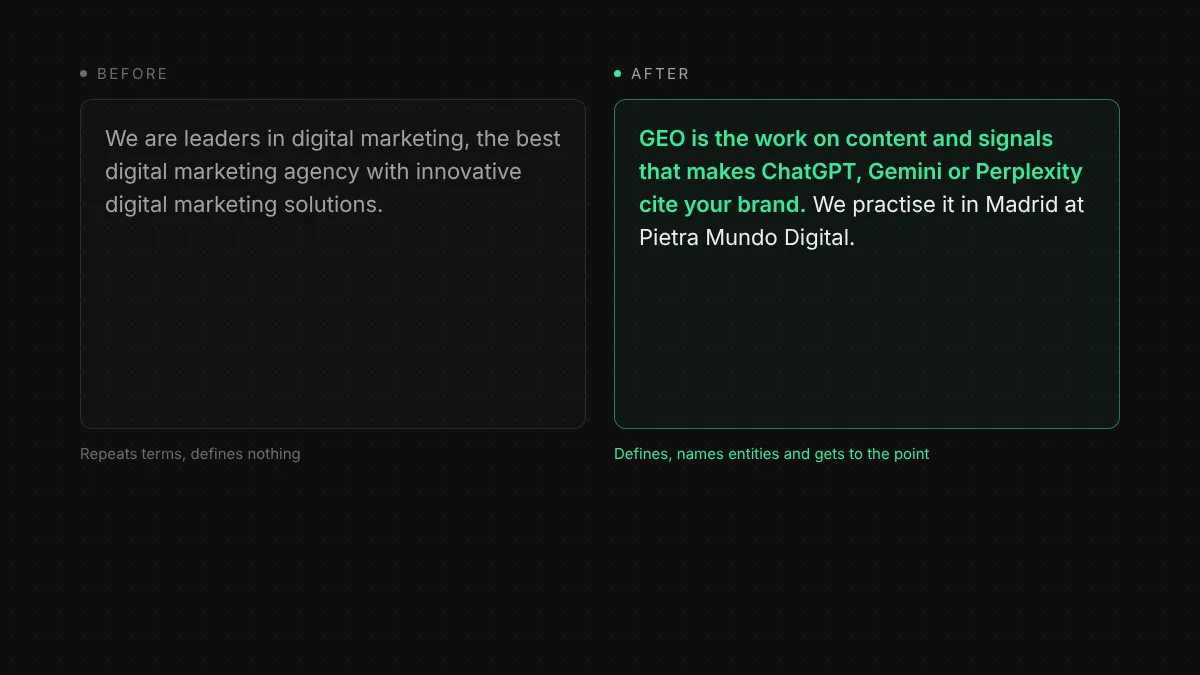
The text on the left could be on any website and says nothing. The one on the right defines the concept in its first sentence, names real entities and leaves context for later.
Is being cited the same as ranking?
No, and it pays to keep them apart. Ahrefs compared the citations of four assistants with Google’s results for 15,000 long-tailLong, specific queries, each with little volume but very numerous together. queries in an August 2025 study. Roughly 12% of the citations from ChatGPT, Gemini and Copilot appeared in Google’s top 10 for that query; for Perplexity, which uses its own index, it was 28.6%. More than 80% of the other assistants’ citations came from pages that didn’t rank for the question.
One important nuance: in an earlier study by the same company, 76% of AI OverviewsAI-generated summaries Google shows above the results for some searches, with links to the sources it uses. citations did come from the top 10. So the link with classic SEO is strong in Google and weak elsewhere. The limits: the ChatGPT data is from early July 2025, and it is an SEO tool vendor studying its own turf.
What follows: ranking in the top 10 helps in AI Overviews, but it isn’t a condition for being cited in ChatGPT, Gemini or Copilot. That is why it pays to measure your AI visibility separately instead of assuming SEO covers it.
What about authority and traffic?
They count too, with caveats. Patrick Stox of Ahrefs calculated the Spearman correlationMeasures whether two variables rise and fall together, from −1 to 1, without requiring a straight-line relationship. The closer to 1, the more they move together; it does not prove one causes the other. between a domain’s organic traffic and its AI mentions. Spearman correlation measures whether two variables rise and fall together, from −1 to 1, without proving one causes the other. In his June 2025 study, covering the 50 most mentioned domains of each system, it came out at 0.47 for AI Overviews, 0.66 for Perplexity and 0.33 for ChatGPT (with p = 0.0515, just above the standard 0.05 threshold, so not significant).
Stox sums it up: “Websites that get more traffic in traditional organic search also get mentioned more in AI Search.” In ChatGPT, Wikipedia also appeared in 16.3% of queries, which shows the weight of reference sources.
The limits: it is a correlation, it covers a single month and ChatGPT doesn’t reach significance. For a small brand, the useful reading is different: traffic and mentions feed each other, so SEO work keeps adding up.
Has anyone tested this?
Two cases, published by the people who ran them, with the same reservations.
Hostinger. Simon Lim reports in their playbook that, with a first batch of 100 articles, the AI citation share went from 3.1% to 4.7% in three months (a 52% relative increase). They applied direct-answer introductions, question-style subheadings, HTML lists and tables, internal linking, comparison pages, author bios, Person and FAQPageA schema.org type for marking up a page of questions and answers. schema and llms.txtProposed file at a site’s root that lists its most useful pages in Markdown so language models can find them. It is a proposal, not an official standard.. The direct-answer framework was, in their words, “the single biggest driver of our success”. Limitations: no control group, six tactics applied at once without isolating each effect, no definition of what counts as a citation or which tool measured it, and the company publishes it itself.
Trex and Seer Interactive. In this case, the agency optimised 39 Trex pages. The keywords where the brand was cited in AI Overviews rose from 71 to 199, and clicks grew 71% over three months against the same prior period. There is no control group here either, and the agency published it.
Neither proves causation. But both line up with Indig: direct answer first, clear structure and concrete language.
How do you rewrite a page, step by step?
- Pick the pages. Start with the ten with the most impressions in Search ConsoleFree Google tool that shows how Google crawls, indexes and ranks your site, and which searches bring users to it., or those answering your customers’ questions.
- Rewrite the first paragraph. One or two sentences answering the title’s question, with the first sentence in bold.
- Define key terms in one sentence the first time they appear.
- Replace the generic with entities. Names of brands, products, people, cities and specific sources.
- Turn subheadings into questions a customer would really ask, and answer in the first sentence of each section.
- Use lists and tables where there are steps or comparisons.
- Add an author bio and structured data (Person, FAQPage) where they fit the content.
- Measure before and after with the same questions and the same method.
What shouldn’t you conclude?
Three cautions. First: none of these sources is a controlled experiment, so none promises results. Second: assistants change often, and what holds in 2026 may stop holding. Third: if your page doesn’t answer the question well, moving the answer to the top won’t fix it.
A simple rule: change one thing at a time, note the date and compare over the following weeks. To see how this fits the rest of the work, also look at what happens to clicks in AI Overviews and this week’s roundups in case studies and news.
What we can do with you
At Pietra Mundo Digital we review your key pages, rewrite the openings, tidy up structured data and measure the effect with a fixed set of questions. All of it is part of our GEO service. To get started, get in touch.